Geophysical instrumentation: MAÅGM and IPGP launch PLANETES
MAÅGM and the Institut de physique du globe de Paris (IPGP) are launching PLANETES, a joint laboratory dedicated to very high-precision geophysical instrumentation. Selected and funded by the French National Research Agency (ANR) under its LabCom 2026 programme, it brings our teams together to develop mechano-optical instruments for space missions and for Earth observation.
> Cliquer ici pour lire cet article en français
A joint laboratory supported by the ANR
PLANETES stands for « Photonique, électronique et mécanique pour une nouvelle exploration de la Terre et du Système solaire » (Photonics, electronics and mechanics for a new exploration of the Earth and the Solar System). The project is led by IPGP, in close collaboration with its Planetology and Space Sciences team and the French national observation service for planetary seismology.
The ANR LabCom programme supports the creation of joint laboratories between a public research organisation and a company. For MAÅGM, this selection gives a long-term framework to its collaboration with IPGP, with a lasting research and development capacity dedicated to instrumentation.
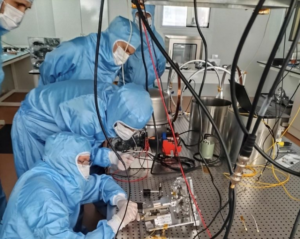
Photo: IPGP. MAÅGM and IPGP teams during the integration of a first lunar seismometer prototype.
Instruments for the Moon, Mars and the icy moons
IPGP designed the SEIS seismometer for NASA’s InSight mission to Mars, and has since worked on developments for the Farside Seismic Suite and South Pole Seismic Suite lunar missions. PLANETES builds on this experience to prepare the instruments of future planetary missions.
The work will focus on new types of measurement: rotation, deformation and gradiometry. In the longer term, these technologies could be used in lunar gravitational wave detectors or in the study of the icy moons of the Solar System.
A shared technological foundation
The laboratory is not tied to a single space mission. It relies on three technological building blocks:
- ultra-high-resolution interferometry
- very low-noise mechanical oscillators
- stable, space-qualifiable electronics.
The methods, characterisation benches and prototypes developed will also be available to other IPGP teams. MAÅGM contributes its expertise in photonics, mechatronics and industrialisation, to take these instruments from prototype to production.
On Earth, sensors for natural hazard prevention
Technologies developed for space will also have applications on Earth. IPGP’s seismology and marine geoscience teams, its volcano and seismic observatories, and the Geoscope observatory will help define requirements and qualify the instruments.
Planned applications include:
- measuring ground rotation
- improving seafloor seismic observations by correcting tilt effects
- monitoring faults and volcanoes
- deploying sensors in extreme environments.
The joint laboratory also builds on proven tools. The LOKI optical interrogator, developed by ESEO and MAÅGM through projects carried out with IPGP, is already in use at the Institute’s observatories. PLANETES will help secure the long-term future of this type of technology.
Towards a French geophysical instrumentation industry
PLANETES combines IPGP’s experience across the full development cycle of space instruments with MAÅGM’s industrial capabilities. Together, the two partners aim to turn one-off projects into a structured French industry for high-precision geophysical instrumentation.
For Sébastien de Raucourt, project manager at IPGP, MAÅGM’s optical expertise meets a specific need of the Institute. Developing applications beyond planetology also strengthens the ecosystem around the high-performance lunar seismometer.
“Working with the team that designed and operated a seismometer on Mars allows us to offer new geophysical sensors to better prevent natural hazards on Earth.” Frédéric Guattari, founder of MAÅGM
This joint laboratory extends MAÅGM’s mission: using light to see the Earth more clearly, and tomorrow other planets.
Read more about our earlier work on lunar seismology: From Mars to the Moon: Advancing Seismology for Planetary Exploration.